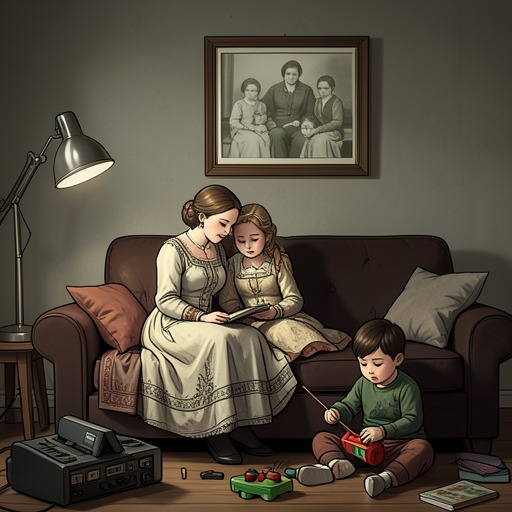
Ambivalence in families affected by addiction
Beautiful Boy: A Father's Journey Through His Son's AddictionAmbivalence in families affected by addiction names the painful coexistence of attachment and alarm: relatives can love the person who is using drugs while fearing that person, resenting the harm addiction brings, and longing for closeness they cannot safely assume. In David Sheff’s account, this conflict belongs not only to Nic but to the whole household, whose routines and emotional lives become organized around his crises.
A Family Drawn Around Addiction
At a family-therapy session, the counselor gives Jasper and Daisy a way to understand feelings that had been difficult to acknowledge. He explains that a child may love a brother and fear him, want to see him and be afraid of him, or direct hatred not at the person but at what his actions are doing to the family and to himself. The concept does not resolve these opposing feelings; it makes their coexistence speakable.
The session follows a period when the children have been carrying Nic’s addiction alongside their parents. At first they hunch into their sweatshirts on the therapist’s couch. As the family discusses experiences that had not been adequately named, they gradually sit more upright. Jasper observes that everybody worries about Nic, then acknowledges, with a small nod, that he also worries about his father after David’s hospitalization. The scene shows anxiety moving through the family in more than one direction: the children are concerned about Nic, but they are also alert to what the crisis is doing to their parents.
Attention, Fear, and the Household’s Roles
An earlier explanation of family dynamics gives this pattern a concrete image. At a treatment-program talk, a mobile hangs above the counselor: a central paper doll represents the addicted person, with smaller figures around it representing the family. David recognizes himself in a figure suspended precariously between Nic and the rest of the household. He describes his role as enabling Nic, making excuses, caring for him, and trying both to protect Karen Barbour, Jasper, and Daisy from him and to keep them connected to one another.
The mobile captures a family pulled toward a single person’s moods and drug use. The counselor explains that an addicted family member can absorb a parent’s attention at the expense of a spouse and other children; everyone’s mood can begin to depend on how that person is doing. Fear can also make relatives controlling and leave little room for identities or pleasures outside the crisis. This account makes ambivalence more than a private emotional contradiction: love and fear coexist within relationships whose ordinary balance has been repeatedly displaced.
That displacement appears in the family’s response to the telephone. After Nic’s thefts, Karen Barbour panics when something is missing, fearing that Nic has entered the house again. A ringing phone produces a similar bodily tension. It may bring news of another emergency, or it may be Nic, whose state is uncertain; if it is not him, there may be disappointment instead. Karen sometimes lets calls go to the answering service during meals or evenings because she does not want to face what might be coming. Jasper notices and asks why she does not answer. A sound as ordinary as a phone ringing has become a cue for fear, hope, and dread of disappointment at once.
Care, Boundaries, and Unresolved Responsibility
David’s attempts to help Nic show how care can pull against self-protection. After Nic is arrested for failing to appear in court on a marijuana-possession citation, David bails him out and tells him it will be the only time, expecting the arrest to teach him a lesson. Later, after learning that Nic has used meth, David pleads with him to enter rehab, but Nic refuses. Because Nic is over eighteen, David cannot commit him to treatment simply because of his drug use. David regrets not having compelled treatment while he still had the legal ability, while recognizing that Nic might not have been ready to hear its message and that there is no way to know whether it would have helped.
This uncertainty persists in David’s reflections on intervention. He favors acting cautiously and earlier rather than waiting until a young person is endangering himself or others, and he believes that forced treatment can at least keep a child off drugs while in a program. At the same time, he does not claim that treatment guarantees recovery. His later position is more conditional: he would help a child return to rehab after relapse, but would not provide money, pay rent or debts, or bail out someone who continued using; help would be directed toward returning to treatment. Care therefore appears neither as unlimited rescue nor as withdrawal of love, but as an effort to draw and redraw boundaries under changing circumstances.
Meaning and Narrative Significance
The book repeatedly holds together ideas that are easy to separate in theory but difficult to live with: addiction may impair a person’s responsibility, yet the person using drugs remains the one who must enter recovery; a parent must establish limits, yet those limits may need revision. David describes learning to live with these contradictions and to love Nic more compassionately even during a life-threatening crisis. The family’s ambivalence is thus not a brief stage on the way to certainty. It recurs as Nic’s condition changes and as each relative confronts a different balance of hope, fear, anger, and attachment.
By naming ambivalence in the therapy room, the family can acknowledge that love does not cancel fear, and fear does not prove an absence of love. The children’s gradual willingness to speak, the parents’ recognition of their own patterns, and the practical question of what help to offer all belong to the same process: making room for conflicting feelings without pretending that Nic’s safety, the family’s safety, or the future is settled.